


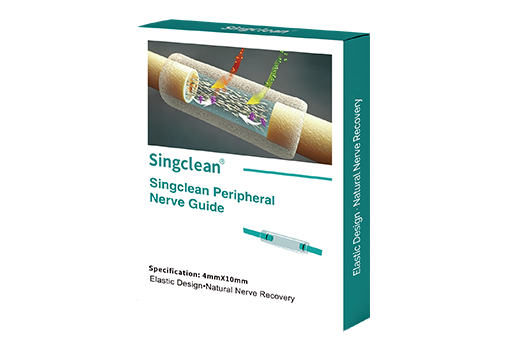
Singclean® Peripheral Nerve Guide
Product Name
Singclean® Peripheral Nerve Guide
Specification
2mm×10mm, 3mm×10mm, 4mm×10mm, 5mm×10mm, 6mm×10mm
Description
The Singclean® peripheral nerve guide is fabricated from chitin-derived chitosan via acetylation to form a hollow tubular configuration, preserved in Water for Injection and packaged in aluminium foil pouches. The product is sterilized by steam. The product is for single use only.
Product Performance
Appearance: White or pale yellow tubular configuration; clean surface free from foreign contaminants, intact structure without cracks, spots or tearing defects.
Dimension tolerance: Inner diameter and overall length shall deviate within ±10% of labelled specifications; tube wall thickness ranges from 0.5 mm to 2.0 mm.
Bacterial endotoxin: Less than 5 EU per unit.
Indications
This product is intended for the repair of peripheral nerves. The length of the nerve defect to be repaired does not exceed 20 mm.
Contraindications
Patients with severe decompensated cardiac, pulmonary, hepatic or renal dysfunction.
Cachexia induced by chronic consumptive diseases intolerant to surgical intervention.
Pathological peripheral nerve injuries.
Acute or chronic local infection adjacent to target peripheral nerve.
Long-segment nerve defects exceeding the defined applicable length.
Infants, children, adolescents, pregnant women and patients planning pregnancy within 12 months postoperatively.
Patients with confirmed hypersensitivity to chitin/chitosan raw materials.
Treatment Procedure
Identify proximal and distal nerve stumps under microscope or direct vision.
Use USP 6-0/7-0/8-0 microsutures for epineurial repair: Suture 2 mm from conduit rim (outside-in) to epineurium 2 mm from nerve transection; limit stitch depth to epineurium only to spare fascicles. Place two 180° separated stitches per stump, four sutures total for proximal & distal ends.
Insert proximal and distal nerve stumps 2 mm into the conduit lumen, leaving an intraluminal gap ≤ 2 mm. Secure the conduit tension-free and avoid nerve stump rotation.
Secure sutures with proper knot tying.
Mandatory 3-week postoperative immobilization of adjacent joints via cast or orthosis, per standard nerve repair postoperative care.
Schematic Diagram of Suture:
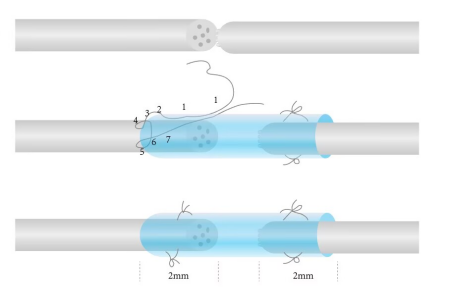
The above surgical procedure is for reference only; surgeons may adjust suturing per patient conditions.
Precautions
This product shall only be used by medical practitioners after receiving specialized training.
Fully mobilize proximal and distal nerve stumps prior to implantation. After epineurial suture of nerve ends, the conduit shall be fixed without tension; postoperative immobilization with cast or orthosis across adjacent joints is required as standard auxiliary management same as conventional neurorrhaphy protocols.
The gap between two nerve stumps inside the implanted conduit shall not exceed 2 mm.
Physicians shall select appropriate conduit size and suture specification on an individual patient basis according to intraoperative anatomical condition.
Adverse Reactions
Potential adverse events include inflammatory response, hypersensitivity reaction, implant-related pain or local discomfort; intraoperative complications including but not limited to surgical trauma, surgical site infection and anesthesia-related complications; risk of conduit rupture after implantation.
Storage
Store at ambient room temperature. The manufacturing date is indicated on the package. The expiry date is indicated on the package.
Shelf Life
24 months .
8.300.04.0011-A0
Issue date:2026.07.07